
Education Health & Science
Fractions, flavors, ‘culinary courage’ for kids
By Javon Huynh
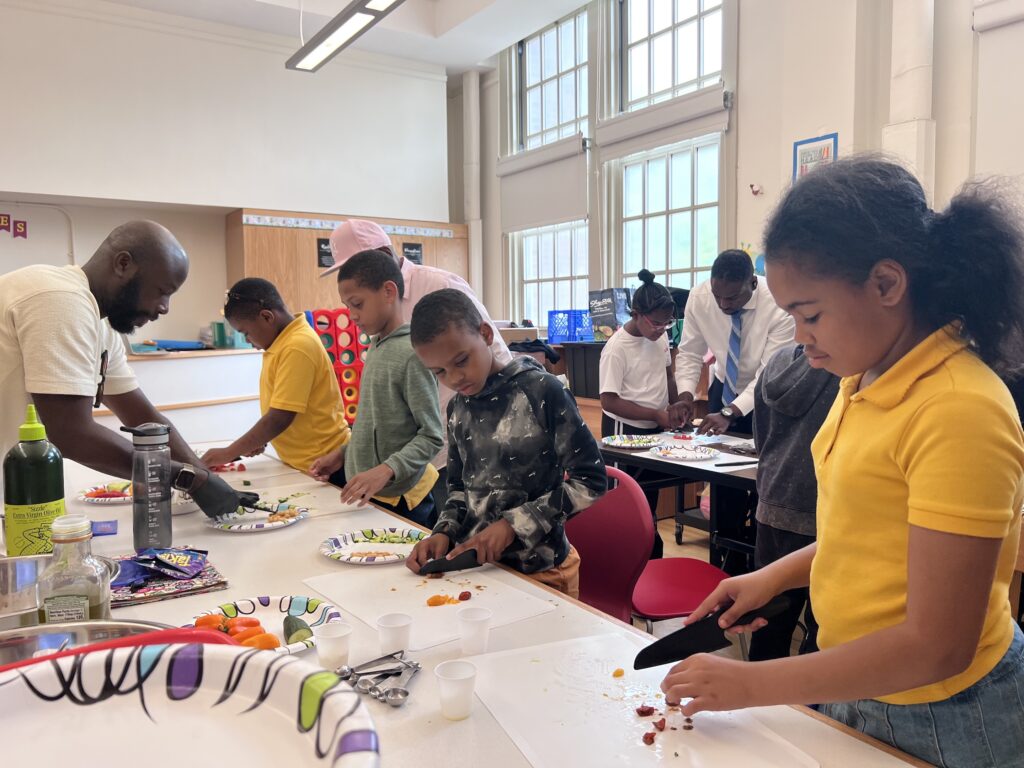
The library at P.S. 191 Paul Robeson School in Crown Heights had been transformed into a makeshift classroom for cooks. Tables were covered with cutting boards, measuring cups and bowls of vegetables. A smart board displayed the day’s lesson, “Mediterranean Rainbow Chickpea Crunch Bowls.”
Before the fourth-graders began preparing the recipe, healthy food educator and chef Justin Simmons quizzed students on measurements and ingredients. When they needed help with the lesson, they called out, “Chef J,” to the man moving from table to table, encouraging them to think through each step before picking up a knife or measuring spoon.
“Whether they put me in the library or the basement, I’m going to find a way to teach these kids no matter what,” Simmons said.
A decade ago, Simmons was working as a restaurant sous chef. Today, as the Brooklyn-based founder and CEO of JS Culinary Group and consultant to the Coalition for Healthy School Food, he uses cooking as a tool to teach life skills, nutrition and confidence.
Previously, he developed health and wellness programs for Harlem Children’s Zone and was director of education programs and partnerships for Spoons Across America. While studying at the Institute for Culinary Education, he worked in restaurant kitchens, including celebrity chef Marcus Samuelsson’s Red Rooster in Harlem. But the demands of restaurant work, combined with what he knew about Harlem families with limited access to fresh food and relatively high rates of diet-related conditions such as obesity and diabetes, led him to reconsider his direction.
“I was preaching, but I wasn’t living the actual teaching that I was giving out,” Simmons said. “I had to make a change.”
Now, Simmons, who earned a master’s degree in food studies from NYU’s Steinhardt School of Culture, Education, and Human Development, teaches food lessons primarily to fourth- and fifth-graders.

Before students began cooking on a recent day, Simmons stood at the front of the room with a measurement chart on a smart board, instructing students to convert teaspoons to tablespoons and apply fractions to recipes. Students called out answers and raised their hands as they worked through how ingredients mix.
“When you look at a recipe, sometimes recipes are written correctly and some aren’t,” Simmons said. “You have to look at it, like, ‘I know this part is going to take longer, so I need to start on this part of the recipe before I start on this part’ … It’s critical thinking.”
He said the lesson also mirrors how a kitchen operates in real time.
“I may be making a hot sauce for your chicken wings, somebody may be making the grits for your shrimp-and-grits, while someone is over here making shrimp. And the flavors need to come together. How do you do that? It’s communication.”
Educators at P.S. 191 — named after athlete, actor and activist Robeson and emphasizing social and cultural issues — say the program reinforces academics in ways traditional instruction often cannot.
“Something I learned is to cook by using math, like using fractions and wholes and halves,” a fourth-grader said.
Another fourth-grade student described learning how to measure ingredients correctly while preparing the day’s recipe.
“At first I didn’t know what to measure,” another fourth-grader said, “and then he showed me what to use and how much to use.”
“It doesn’t really come together in any other place in the building other than in a class like this,” Principal Andy Jones Duncan said. Students calculate math for their recipes, while also learning about food history, farming, how food fuels the body and where ingredients come from.
For the day’s Mediterranean-themed recipe, Simmons explained that feta cheese originated in Greece. He encouraged students to think about how food reflects culture, geography and history.
“Food tells a story,” Duncan said. “It tells the story of the people who have come before you. And, then, you can also tell your story.”
She said the program also exposes students to real-world skills and careers they might not otherwise encounter. “When in their life would they come face to face and experience a private chef?” she said. “Most of us never do.”
A worker at the New York City Department of Education’s Office of Food and Nutrition Services, which funds the program, said food education is expanding across the city as part of broader efforts to connect students with healthier eating habits at school and at home.
“We want teachers to talk to students about healthy eating. We try to build communities with families and neighborhoods,” said the representative, who requested anonymity. The person was not authorized to speak publicly on behalf of the department.
Bruce Wright, a foster grandparent volunteer who assists fourth-grade teachers, said things were a bit frenetic when the program started. “But as they kept coming, they were more engaged.”
He said students are now more willing to try new foods, including vegetables they previously avoided. “Nowadays, everything is sugar, candy, cookies, potato chips,” Wright said. “This is a good way to teach them nourishment and nutrition and how to eat right.”
Students are increasingly choosing vegetables such as bell peppers, cucumbers and chickpeas after participating in cooking lessons, Simmons said. He calls it building “culinary courage” and confidence.”They really are diversifying their plate,” Duncan said. “That’s ultimately what the goal of this was.”
As students gathered around the table to taste the salad they prepared, teachers joined them, filling plates and discussing flavors.