
Arts & Culture History News
At the Schomburg, 100 years of diasporic study and archiving
By Kordell Martin
Kevin Matthews was pondering these times as the Schomburg Center for Research in Black Culture approached its 100th anniversary festival saluting that world-class library.
“We haven’t lost anything,” said the center’s deputy director, about being among Black institutions from which the Trump White House has blocked federal funding.
Some people say we got a lot of malice, some say it’s a lot of nerve. But I say we won’t quit movin’ until we get what we deserve …
As Matthews spoke, those lyrics from James Brown’s 1960s anthem, “Say It Loud — I’m Black and I’m Proud,” were coming through a Bluetooth speaker hanging from the ceiling of a space housing a special centennial exhibit. It showcased such items as a bust of Ira Aldridge, the first Black actor to play Othello on a London stage and photos including ones from the Schomburg’s opening in 1925 and of such famous actors and civil rights activists as Ruby Dee and Harry Belafonte.
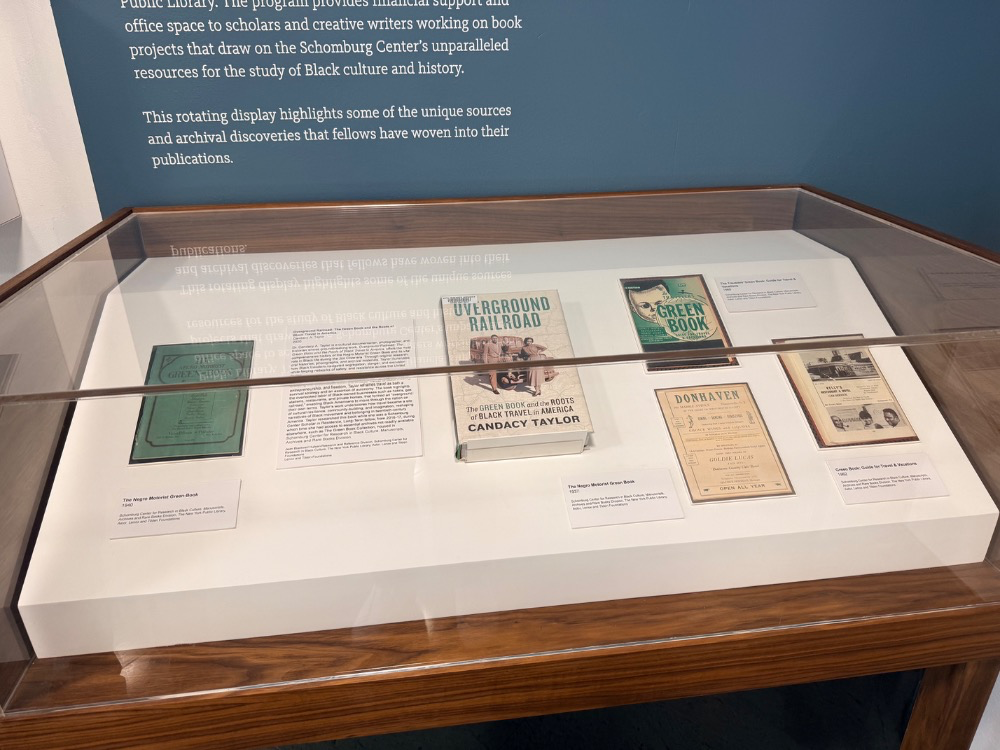
Items on display elsewhere in the center also helped to tell Black America’s story. They included “The Negro Motorist Green Book,” first published in 1938, mapping where Black people could eat, stay and shop, often with Black-owned businesses, across a segregated America.
Overcoming challenges — even a major cut in federal funding — is what Black people and institutions historically have done, Matthews said.
“When someone says, ‘We want to sanitize American history,’ what they’re actually doing is … saying they’re making choices about what we want you to learn and what we don’t want you to learn.”
That was his take on Trump’s March 2025 executive order, Restoring Truth and Sanity to American History. It has stripped, for example, mentions of slavery from national parks and eliminated funding for projects that “inappropriately disparage Americans past or living.”
The Schomburg Center had planned to spend the $250,000 it lost to turn books and other documents from its archives into curricula for 6th- through 12th-graders.
Despite a judge ruling the cuts illegal in November 2025, the Schomburg’s leaders chose not to try to get the grant reinstated. The center would not, Matthew said, play a game of yo-yo over revoked funding.

The Schomburg may be able to survive without such a grant. But smaller organizations that also are devoted to the history and uplift of Harlem and Black America, including While We Are Still Here, can’t afford to continue archival projects without such funding.
“The frustration comes in not having enough money to build a proper infrastructure for the organization to thrive to the point where we could have our own space for exhibitions and performances,” said Karen Taylor, founding director of While We Are Still Here.
The group won a $250,000 grant in September 2024 from the National Endowment for the Humanities. Months later, the Trump administration reneged on that deal. The organization had to downsize its search for family photographs, documents and other artifacts from Harlem residents. Already, lack of funding means items the organization has collected can’t be adequately stored and displayed.
Though a judge ruled that the cuts were unconstitutional in May, While We Are Still Here continues to wait for the money.
“It’s even more important,” Taylor said, “that people stick to their guns and keep engaging in all kinds of scholarly research about the kinds of contributions that Black people have made to this country and the world”
To celebrate what it’s done in that regard for 100 years, the Schomburg festival featured Black authors, comic books with Black characters and Harlem-based community groups promoting physical fitness, culinary therapy and other ideals. It included panel discussions with authors and Schomburg staff about community engagement and the significance of literacy.
The festival was Bronx-native Kecia Johnson’s first experience at the center, browsing pop-up shops and rummaging through tables of free books lining West 135th Street, near the Schomburg’s entrance.
“It’s very important to have these go on because they’re trying to wipe everything away,” Johnson said. “So, it’s good for the kids to know this because a lot of kids don’t even know.”
Johnson said such events acknowledge Black success and teach Black children the value of their identity.
“They see more representation, positive representation of themselves,” Johnson said. “Then, they know, ‘Okay, we can do this.’”