
Business Education
Inviting the boss to dinner, hoping for a gig
By Denzel Massaley
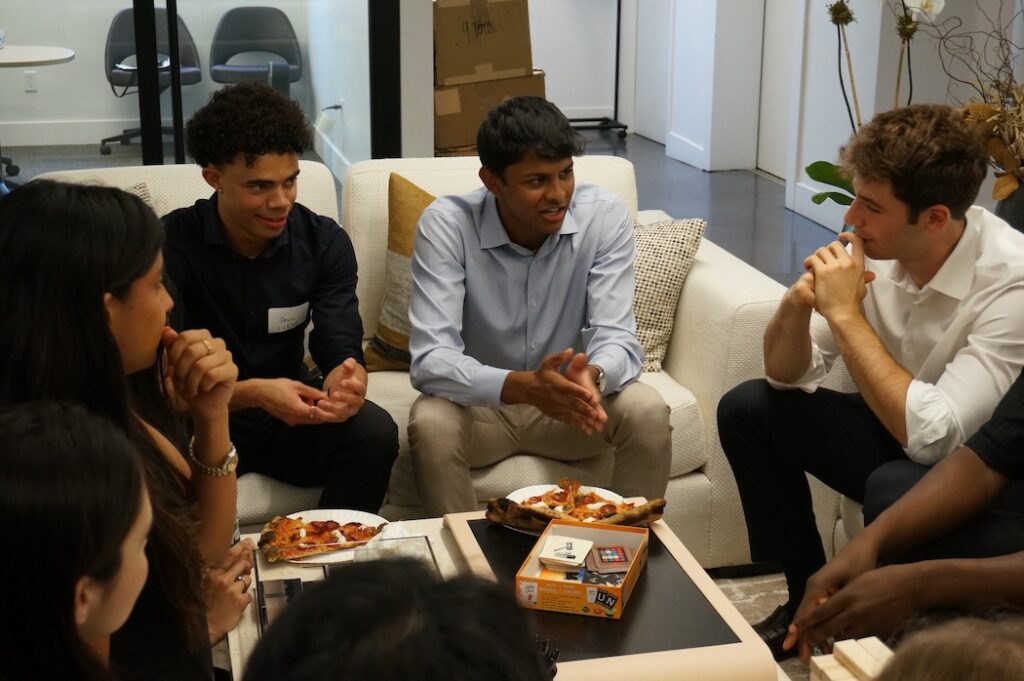
Inside a lounge at BoxGroup, a tech venture-capital fund, college students mingled with company employees during a private dinner organized by Chelsea Commons. It aims to help its 12 college student founders and interning peers get face-to-face with potential employers — instead of just cold-calling, blind-emailing or otherwise waiting to hear back from recruiters for future jobs.
The June gathering was the organization’s second networking event, said Sachin Sashti, 21, a Pennsylvania State University finance, accounting and philosophy major and summer 2026 intern at KPMG, the global professional services firm. He created Chelsea Commons. Just as Chelsea Commons connects potential employers with interns, it also hosts Jenga and Codenames game nights and spikeball sporting events.
A summer in New York is a time to grow and explore job interests, Sashti said. “I’m trying to really understand what it is that I want to do after college [and] why it is that I want to do it.”
“It honestly feels kind of surreal,” he said of that pizza dinner, which he’d been laying the groundwork for since last January. For Sashti, Chelsea Commons is a launchpad where young professionals can kickstart the relationships that support their careers.

It’s an urgent time for young workers, say economists and others who are watching how hard it has been for them to find jobs recently. A Gallup poll, released in May 2026, found that 15- to 34-year-olds in the United States ranked 87th among 141 countries in pessimism about the job market. New grads are concerned about hiring rates, which declined over the last three years, returning to levels seen in 2013 and 2014 as the Great Recession persisted, according to a May 2026 Economic Policy Institute report.
As of March 2026, 41.5% of recent college graduates worked jobs that didn’t require a college degree, according to the U.S. Census Bureau and U.S. Bureau of Labor Statistics. Also, the joblessness rate for recent grads was 5.6%, above the overall rate of 3.1% for all college graduates and 4.2% for all workers.
Investor and entrepreneur Coyne Lloyd, Sashti’s mentor, connected Chelsea Commons with other investors and venture capitalists. “The main thing that people get wrong about networking is that they try to just attach themselves to people that they think vaguely can help them,” Lloyd, 38, said. “Throw away the idea of just trying to connect with people for the sake of connecting with them. But really, actually think about connecting with people around your interests.”
Networking matters, Sashti said. “People’s networks are getting increasingly more important … ”
Networking is a two-way street with potentially mutual benefits. It supports students at the start of their careers and can lead to something in the long term.
“Maybe some of them start companies and maybe some of them end up working at our portfolio companies,” said Disha Karale, an investor at BoxGroup.
Ava Payman, another investor at BoxGroup added, “A lot of what we do is investment over a really long time horizon. And, so, it’s not necessarily today or tomorrow [that] we’ll see some sort of return on this dinner.
“But even if, seven years from now, someone who is here had a really positive impression of BoxGroup and they decide to start a company and they loop us in because they remember that when they were a junior at Georgia Tech, they came to dinner at our office … that will have been worth the investment here.”
In a labor market that challenges young professionals — with hiring lags, fewer people leaving their jobs and questions of whether a college degree is worth the cost — members of Chelsea Commons have found a way to flip the script.
As of mid June, the organization had 10 more events lined up for the summer.