
Arts & Culture Entertainment
In a Brooklyn brownstone, parlor jazz
By Marquis Chambers
Photos by Brandon Aninipot
It started with a Friday night fish fry to celebrate a beloved person who’d died.
“My cousins played drums. I danced. We cooked food. We celebrated. And from there, things just started to happen,” said Debbie McClain, of what was happening in her Brooklyn backyard.
Jazz lover McClain’s friend Eric Lemon was on bass that night.
From their windows, McClain’s Bed-Stuy, Brooklyn neighbors listened to the music and watched the dancers. “Jazz Under the Stars” is the name she gave to that night of mourning, remembering and making merry.
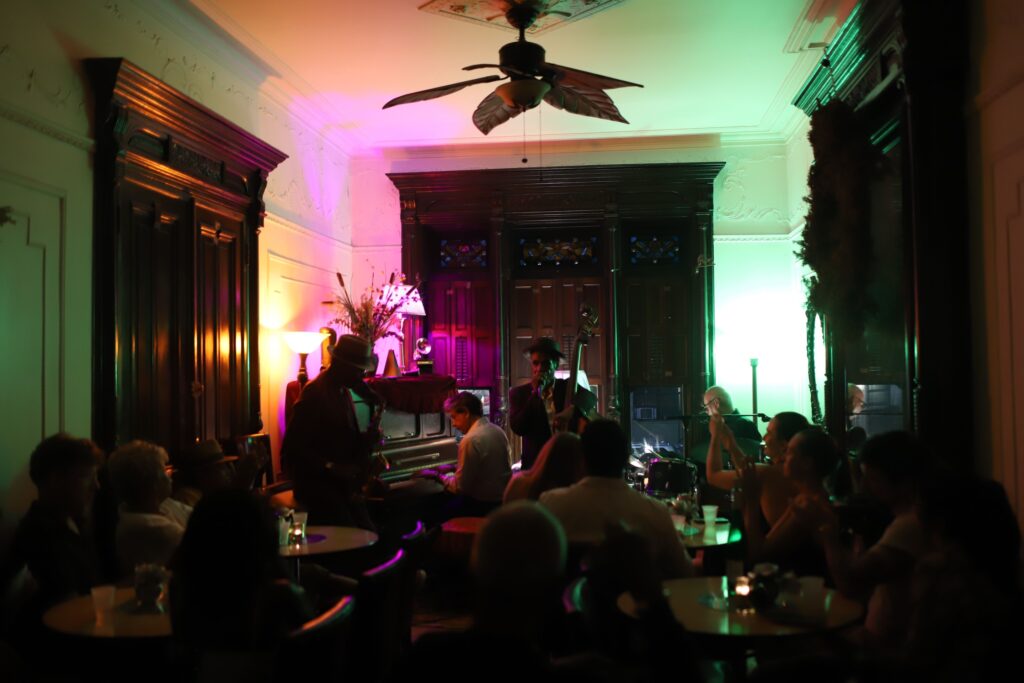
She and her friends have kept that groove going, but moved it indoors. What morphed into Brownstone Jazz 17 years ago is now a weekend-long jazz show — for every weekend this summer — inside McClain’s home. Already, she was running Sankofa, a bed-and-breakfast, there on Macon Street.

Her musician friend Lemons, 67, actually came up with the idea for moving the starlit event to McClain’s parlor. McClain was hesitant, at first. “There were already clubs and venues where people gathered to hear jazz,” she said.
She should know. She’d worked as a bartender and a DJ in several jazz clubs throughout Manhattan and Brooklyn. She was a hostess at Town Hall, which has featured such artists as Ray Charles and Lou Rawls. “Working in clubs is part of my life, but this? This is for the people,” she added. “This is for family. That’s why it feels different.”
There isn’t enough jazz in the world, as far as McClain is concerned. But there are still plenty of jazz lovers. One Friday night in June, 19 people sat at bistro tables and chairs during the first set and 17 were at the second. The space can accommodate 30 people at a time.
“Hearing the music tonight reminded me of my love,” Dianne Beveridge, 79, said, referring to her late husband. “It brought me joy, just a little more joy in my life.”
Hearing good music in a neighborhood where many cultural traditions have been built and passed down is part of the enticement for Chris Homan, 56, and Michelle Harris, 58. That Friday, they were venturing into McClain’s parlor for the first time.
“It’s lovely to experience this music in context, as opposed to just hearing it on the radio, on an album, on a CD, or even on YouTube,” Homan said. “It’s wonderful to hear it performed live by people who are keeping the tradition alive — in a place connected to where the music came from.”
McClain takes special pride in being one of four Black-owned jazz spaces in the boroughs. The others are Bill’s Place in Harlem and, in Brooklyn, Williamsburg Music Center and Sistas’ Place.
Between songs, Lemons would take to the mic and give some history about the musicians who helped shape bebop and the Black artists whose contributions rarely make it into school lessons.
Each June, Black Music Month shines a particular spotlight, said McClain, who has loved jazz for a long time. She won’t say exactly how long and dismisses a question about how old she is: “You can’t have my age. I don’t do that.”
The music month, established in 1979, McClain said, “means celebrating the music and the people who created it. But honestly, we do that all year long, January through December. It doesn’t stop.”
“These people impacted the whole world,” said Lemons, of jazz artists. “Not just the music world. They impacted the way we hang, the way we dress, the way we talk.”